Purity Guaranteed
100% Traceable to Himalayan Farmers
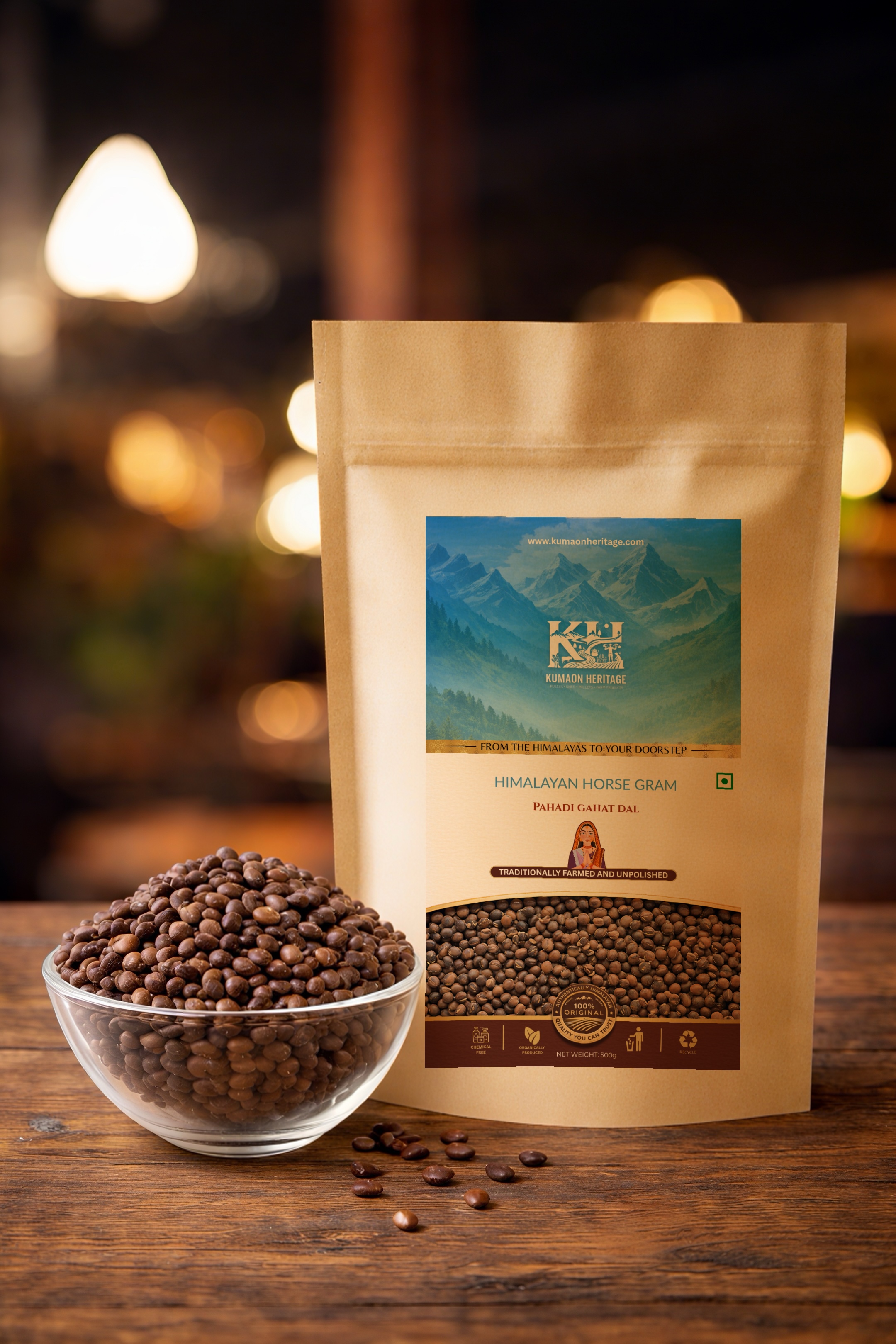
Himalayan Horsegram (Gahat) (500gm)
Often referred to as the 'Miracle Pulse,' Gahat has been the backbone of the Himalayan winter diet for centuries. This small, powerhouse legume is revered in Ayurveda for its ability to generate internal body heat and its potent medicinal properties. Our Gahat is rain-fed and grown on steep terraced slopes, concentrating its earthy, robust flavor.
Standard delivery: 3-5 business days
Health Benefits
- Famous in traditional medicine for effectively dissolving kidney and gallbladder stones.
- High phenolic content provides strong antioxidant protection.
- The 'warm' nature of the pulse helps combat the harsh Himalayan winters.
Traditional Preparation
Try the traditional 'Gahat ki Churkani'. Grind soaked Gahat into a coarse paste for 'Phanu' or slow-cook the whole beans in an iron kadhai. The iron pot reacts with the dal to give it a rich, dark color and boosts the nutritional value. Season with Gandrayani (Himalayan angelica root) for an authentic aroma.
Customer Experience
“Very clean pulses, no stones. Excellent quality.”
“Bought this for its medicinal properties. The quality is far superior to what I found in local organic stores.”
“Gahat ke paranthe came out amazing. This is the real Pahadi Gahat!”
Frequently Asked Questions
Is it true that Gahat helps with kidney stones?
In traditional Ayurvedic and Himalayan folk medicine, Gahat (Horsegram) is highly valued for its diuretic and litholytic properties, which are believed to help in dissolving and flushing out small kidney stones. However, we recommend consulting a healthcare professional for medical concerns.
Why does the dal turn dark when cooked?
Pahadi Gahat is traditionally cooked in an iron vessel (Kadhai). The natural polyphenols in the dal react with the iron, turning the gravy a deep, dark color. This process also naturally fortifies your meal with dietary iron.
Is Gahat suitable for summer consumption?
Gahat is 'Tamsik' or 'warm' in nature, meaning it generates internal body heat. While it is a staple in Himalayan winters, in hotter climates, it is best consumed in moderation during summers or paired with cooling ingredients like curd.
How long should I soak Gahat before cooking?
Since these are hardy, high-altitude grains, we recommend soaking them for at least 6-8 hours or overnight. This reduces cooking time and makes the nutrients more bioavailable.
Can I use the soaking water?
Yes! In the Himalayas, the water used to soak Gahat is often consumed as a health tonic or used as the base for the dal itself, as it contains many of the water-soluble nutrients.